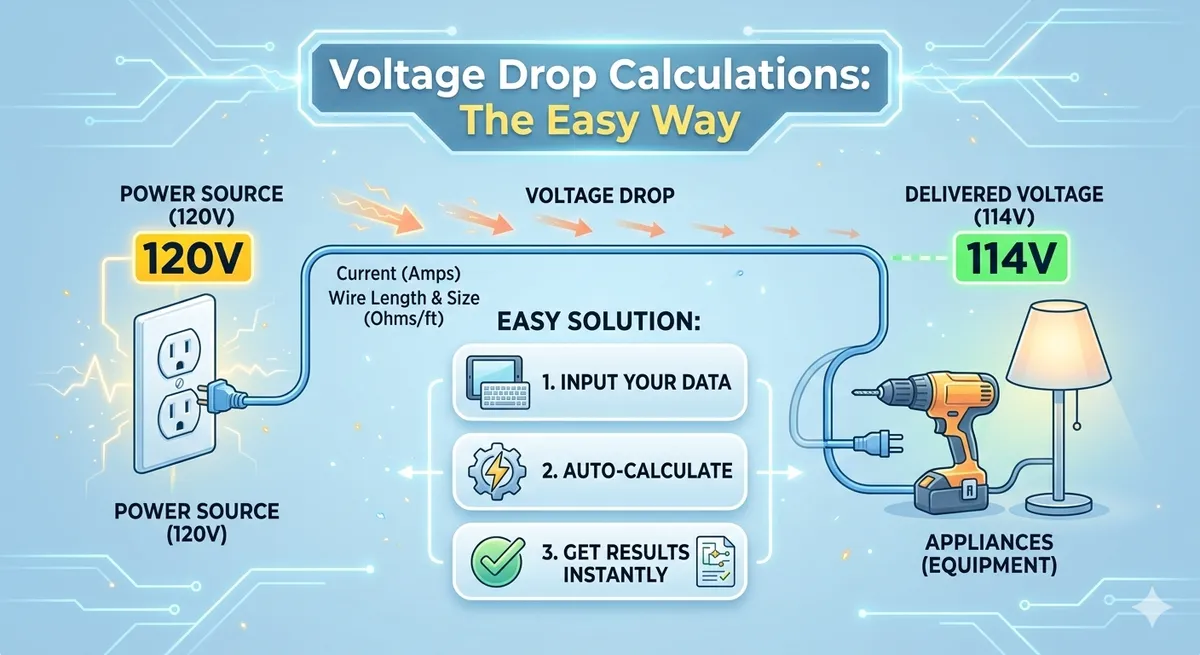
Memorize these core formulas and you can solve any voltage drop question the CSLB exam throws at you.
Voltage drop calculations are a staple of the C-10 exam. The good news: there's really only one formula you need to memorize, and once you understand it, these questions become easy points.
The NEC Voltage Drop Recommendations
The NEC recommends (but does not mandate) maximum voltage drop limits in Section 210.19(A)(1) Informational Note No. 4 and 215.2(A)(4) Informational Note No. 2:
- Branch circuits: Maximum 3% voltage drop
- Feeder + branch circuit combined: Maximum 5% total voltage drop
- Feeders alone: Maximum 3% (to leave room for 2% branch circuit drop)
While these are recommendations, the C-10 exam treats them as requirements for calculation purposes. If a question asks for "maximum voltage drop," use 3% for branch circuits and 5% for the total system.
The Core Formula
The voltage drop formula for single-phase circuits:
VD = (2 × K × I × D) ÷ CM
Where: VD = Voltage Drop (volts) | K = Resistivity constant | I = Current (amps) | D = Distance (feet) | CM = Circular Mils
Understanding each variable:
- VD (Voltage Drop): The voltage lost in the conductor, measured in volts.
- K (Resistivity): 12.9 for copper conductors, 21.2 for aluminum conductors. Memorize these two values.
- I (Current): The load current in amperes flowing through the conductor.
- D (Distance): The one-way distance from the source to the load in feet (not the total wire length). The "2" in the formula accounts for the round-trip.
- CM (Circular Mils): The cross-sectional area of the conductor in circular mils. Common values: #14 = 4,110 CM, #12 = 6,530 CM, #10 = 10,380 CM, #8 = 16,510 CM, #6 = 26,240 CM.
Memorize These CM Values
You won't have the NEC tables in front of you, so memorize the circular mil values for the most common conductor sizes. The exam frequently uses #12, #10, #8, and #6 AWG in voltage drop questions. A helpful pattern: each AWG size roughly doubles the CM of the size two steps smaller (#12 ≈ 6,500, #10 ≈ 10,400, #8 ≈ 16,500).
Three-Phase Voltage Drop
For three-phase circuits, the formula changes slightly because the geometry of the circuit is different:
VD = (1.732 × K × I × D) ÷ CM
The only difference is replacing the "2" with "1.732" (√3). All other variables remain the same. The exam will typically specify whether the circuit is single-phase or three-phase.
Worked Example
Question: What is the voltage drop on a 120V, single-phase circuit using #12 copper conductors carrying 16 amps over a distance of 100 feet?
- VD = (2 × 12.9 × 16 × 100) ÷ 6,530
- VD = 41,280 ÷ 6,530
- VD = 6.32 volts
- Percentage: (6.32 ÷ 120) × 100 = 5.27%
- This exceeds the 3% recommendation (3.6V max). You would need to upsize to #10 AWG.
Solving for Other Variables
The exam may ask you to solve for different variables. Rearrange the formula:
- Find minimum conductor size: CM = (2 × K × I × D) ÷ VD(max)
- Find maximum distance: D = (VD × CM) ÷ (2 × K × I)
- Find maximum current: I = (VD × CM) ÷ (2 × K × D)
For "find minimum conductor size" questions, calculate the required CM, then select the next larger standard conductor size from your memorized CM values.
Percentage Voltage Drop
To convert voltage drop in volts to a percentage, use:
%VD = (VD ÷ Source Voltage) × 100
Be careful with the source voltage: use 120V for 120V circuits, 240V for 240V circuits, 208V for 208V three-phase, and 480V for 480V three-phase. The percentage references the source voltage, not the load voltage.
Exam Day Tip
Write the voltage drop formula on your scratch paper immediately during your brain dump. Include the K values (12.9 copper, 21.2 aluminum) and the CM values for common conductors. With these written down, voltage drop questions become straightforward plug-and-solve problems.
Ready to Pass Your Exam?
Put your knowledge to the test. Try our free California C-10 practice test to see where you stand, or upgrade to our Premium Preparation Course for unlimited mock exams, detailed explanations, and a 100% pass guarantee.
Recommended Articles
Mastering NEC Load Calculations for the C-10 Exam
Step-by-step guide to the most complex math problems you'll face on the CSLB C-10: dwelling unit standard and optional calculations.
Grounding vs. Bonding: Finally Explained Simply
Clear up the confusion between grounding and bonding once and for all. Essential knowledge for Article 250 questions on the trade exam.
How to Use NEC Tables Like a Pro for the Trade Test
Stop guessing on wire sizing. Learn how to apply temperature correction and adjustment factors correctly under closed-book conditions.