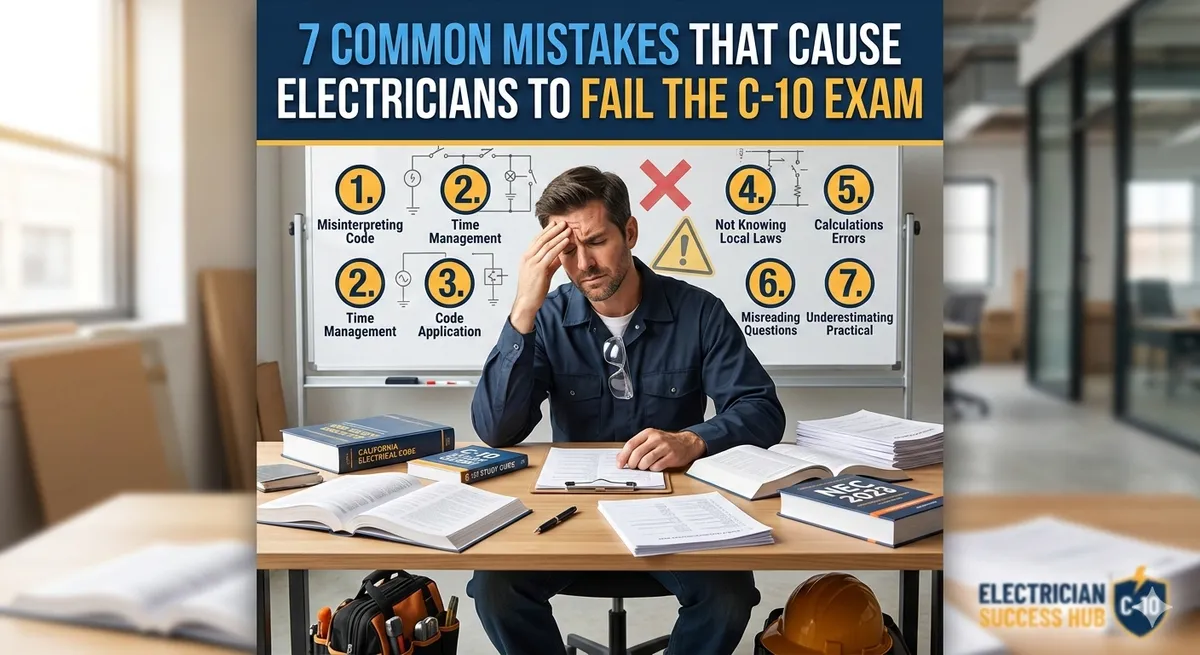
Learn from the failures of others. We analyzed common pitfalls in the C-10 trade portion to help you pass on your first try.
We surveyed hundreds of CSLB exam candidates and analyzed the most common reasons people fail the C-10 exam on their first attempt. Here are the seven mistakes you need to avoid.
Mistake #1: Treating It Like an Open-Book Exam
Many experienced electricians assume the C-10 will be like their journeyman exam or other trade tests that allow reference materials. The CSLB C-10 exam is completely closed-book. No NEC code book, no notes, no reference materials of any kind. This means every formula, every key NEC value, and every California-specific regulation must be memorized before exam day.
Fix: Start memorizing key formulas and NEC table values at least 4 weeks before your exam. Use flashcards, write formulas daily, and practice calculations without any reference materials.
Mistake #2: Ignoring the Law & Business Exam
Electricians often focus 90% of their study time on the Trade exam because it covers their area of expertise. But the Law & Business exam has its own passing requirement — 72% on 115 questions. You cannot get your C-10 license even if you score 100% on the Trade exam but fail L&B.
The L&B exam covers mechanics lien law, Cal/OSHA safety requirements, contract law, employee classifications, and financial management. These topics require dedicated study time. Many candidates report that the L&B exam was actually harder than expected because it covers so many different subject areas.
Fix: Allocate at least 30-40% of your total study time to Law & Business. Focus especially on mechanics liens (deadlines and procedures), workers' compensation requirements, and California Business & Professions Code sections related to contractor licensing.
Mistake #3: Not Practicing Under Timed Conditions
Knowing the material is one thing — applying it under pressure is another. With 115 questions in 210 minutes, you have less than 2 minutes per question. Calculation questions can easily eat up 5-7 minutes if you're not practiced.
Fix: Take at least 3-4 full-length practice exams under strict timed conditions before your test date. No breaks, no reference materials, no pausing the timer. This builds the mental stamina needed for the real exam.
Mistake #4: Memorizing Answers Instead of Understanding Concepts
Some candidates memorize practice test answers rather than understanding the underlying concepts. The CSLB regularly updates their question bank, so while the topics stay the same, the exact questions will be different. If you only memorized "the answer to question 47 is C," you'll be lost when the question is reworded.
Fix: When studying practice questions, focus on understanding why the correct answer is correct and why the other options are wrong. This conceptual understanding transfers to any version of the question.
Mistake #5: Skipping Motor Circuit Questions
Motor circuit calculations (Article 430) are among the most complex topics on the C-10 exam, and many candidates simply guess on these questions. But motor questions can account for 10-15% of the Trade exam. That's the difference between passing and failing.
The key confusion points are: using FLC from NEC tables (not nameplate FLA) for conductor sizing and short-circuit protection, but using nameplate FLA for overload protection. These rules are counterintuitive and frequently tested.
Fix: Dedicate specific study sessions to motor circuits. Practice the complete motor circuit calculation process: conductor sizing (125% FLC), overload protection (115% or 125% nameplate FLA), and short-circuit protection (from Table 430.52). Repetition is key.
Mistake #6: Poor Time Management on Exam Day
Some candidates spend 5-10 minutes agonizing over a single question they're unsure about, then run out of time and have to rush through the remaining questions. Others finish too early and don't review their answers.
Fix: Use the two-pass strategy. First pass: answer every question you know immediately (spend max 1 minute per question). Flag uncertain questions and move on. Second pass: return to flagged questions with remaining time. Always leave 15-20 minutes for a final review.
Mistake #7: Not Understanding California-Specific Requirements
The C-10 exam is a California exam, not a generic NEC exam. California adopts the NEC with amendments under Title 24, and the exam tests these California-specific requirements. Key areas where California differs:
- Cal/OSHA vs. Federal OSHA: California's occupational safety requirements are more stringent than federal standards.
- Solar PV requirements: California mandates solar on new residential construction since 2020.
- EV charging readiness: New construction must include EV charging infrastructure or pre-wiring.
- Energy Code (Title 24 Part 6): Lighting efficiency and controls requirements specific to California.
- Seismic bracing: Special requirements for electrical equipment in seismic zones.
Fix: Study with materials specifically designed for the California C-10 exam. Generic "electrician exam prep" materials may not cover these California-specific topics.
Bottom Line
Most people who fail the C-10 exam don't fail because they're not smart enough or don't have enough experience. They fail because they didn't prepare correctly. Avoid these seven mistakes, put in the study time, and use quality practice materials, and you'll be well-positioned to pass on your first attempt.
Ready to Pass Your Exam?
Put your knowledge to the test. Try our free California C-10 practice test to see where you stand, or upgrade to our Premium Preparation Course for unlimited mock exams, detailed explanations, and a 100% pass guarantee.
Recommended Articles
How to Prepare for the California C-10 Electrical Contractor Exam
A comprehensive guide to studying for the C-10 exam, including recommended books, study schedules, and what to expect on test day at the PSI center.
Top 5 NEC Articles Every C-10 Candidate Must Know
Don't waste time memorizing the entire code book. These 5 articles appear on over 60% of C-10 trade exam questions.
C-10 Exam Day: What to Expect at the PSI Center
Walk through the entire exam day process, from check-in procedures to the computer interface and time management strategies for the 3.5-hour test.