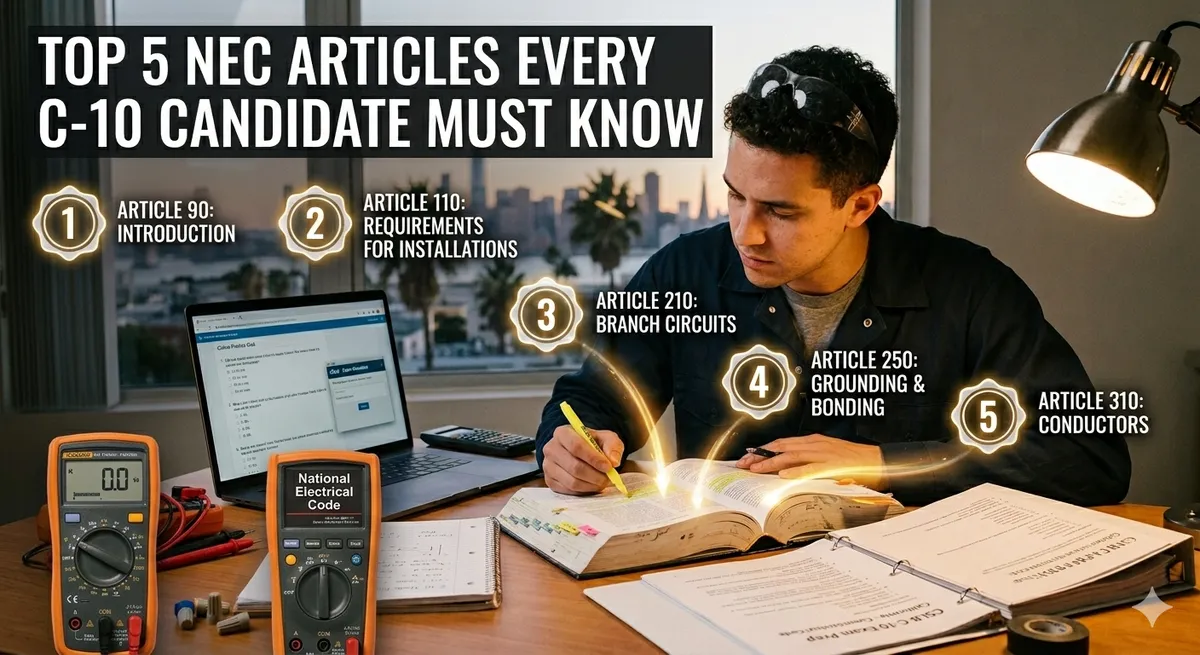
Don't waste time memorizing the entire code book. These 5 articles appear on over 60% of C-10 trade exam questions.
The NEC contains hundreds of articles, but on the CSLB C-10 exam, certain articles appear far more frequently than others. Mastering these five articles will give you a significant advantage on exam day.
Article 210 — Branch Circuits
Article 210 governs the installation and sizing of branch circuits. On the C-10 exam, expect questions about:
- Circuit ratings and overcurrent protection: The relationship between conductor size, overcurrent device rating, and connected loads.
- Required outlets and receptacles: Spacing requirements for dwelling unit receptacles (every 12 feet along the wall), GFCI protection locations (bathrooms, kitchens, garages, outdoors), and AFCI protection requirements for bedrooms and living areas.
- Small appliance and laundry circuits: The two required 20A small-appliance branch circuits in kitchens and the dedicated laundry circuit requirement.
- Bathroom circuits: Dedicated 20A circuit requirements and GFCI protection.
Article 220 — Branch-Circuit, Feeder, and Service Load Calculations
This is arguably the most important article for the C-10 exam. Article 220 contains the methods for calculating electrical loads, which form the basis of many exam questions.
- Standard Method (220.40-220.60): General lighting loads, small appliance loads, laundry loads, and the application of demand factors from Table 220.42.
- Optional Method (220.82-220.87): Know when this method can be used (existing dwelling units with 100A or larger service) and how to apply it.
- Demand factors: Memorize the demand factor tables for general lighting (Table 220.42), dryers (Table 220.54), cooking equipment (Table 220.55), and fixed appliances.
- Service and feeder sizing: How to sum individual loads and apply appropriate demand factors to determine minimum service entrance requirements.
Study Tip
For Article 220, practice working through complete dwelling unit load calculations from start to finish. The exam often presents a scenario and asks you to calculate the total service load. Being able to work through the entire process quickly is essential for time management.
Article 250 — Grounding and Bonding
Grounding and bonding is one of the most complex and frequently tested topics on the C-10 exam. Article 250 covers the entire grounding system from the service entrance to the equipment level.
- System grounding vs. equipment grounding: Understanding the difference between grounding (connecting to earth) and bonding (connecting conductive parts together) is fundamental.
- Grounding electrode system (250.50): What constitutes a grounding electrode and how they must be connected.
- Grounding electrode conductor sizing (Table 250.66): How to size the GEC based on the largest service-entrance conductor.
- Equipment grounding conductor sizing (Table 250.122): How to size the EGC based on the overcurrent device rating.
- Main bonding jumper and supply-side bonding jumper requirements.
Article 430 — Motors, Motor Circuits, and Controllers
Motor circuits have unique rules that differ from general branch circuit requirements. The C-10 exam frequently tests your understanding of these special requirements:
- Full Load Current (FLC) vs. nameplate FLA: Always use the NEC table values (Tables 430.247-430.250) for conductor sizing and short-circuit protection — never the nameplate rating.
- Conductor sizing: Motor branch circuit conductors must be rated at 125% of the motor FLC (430.22).
- Overload protection: Sized based on nameplate FLA, typically at 115% for service factor 1.15 or higher, or 125% for all other motors.
- Short-circuit and ground-fault protection: Maximum ratings from Table 430.52, which vary by motor type and protective device type.
- Disconnecting means: Requirements for motor disconnect location and rating.
Article 310 — Conductors for General Wiring
Article 310 governs conductor selection, and Table 310.16 is one of the most referenced tables in the entire NEC. For the C-10 exam:
- Conductor ampacity (Table 310.16): Know the ampacity ratings for common conductor sizes in the 60°C, 75°C, and 90°C columns. Most questions reference copper conductors.
- Temperature correction factors: How to adjust ampacity for ambient temperatures above 30°C using the correction factors at the bottom of Table 310.16.
- Adjustment factors for bundling: When more than 3 current-carrying conductors are in a raceway, you must apply adjustment factors from Table 310.15(C)(1).
- Terminal temperature limitations: Even if a conductor is rated for 90°C, the ampacity may be limited by the terminal rating (usually 60°C or 75°C) of the equipment it connects to.
Exam Strategy
While these five articles cover the majority of exam questions, don't completely ignore other articles. You should also have a working knowledge of Article 240 (Overcurrent Protection), Article 300 (General Requirements for Wiring Methods), and Article 334 (NM Cable / Romex) as these topics also appear regularly on the C-10 trade exam.
Ready to Pass Your Exam?
Put your knowledge to the test. Try our free California C-10 practice test to see where you stand, or upgrade to our Premium Preparation Course for unlimited mock exams, detailed explanations, and a 100% pass guarantee.
Recommended Articles
How to Prepare for the California C-10 Electrical Contractor Exam
A comprehensive guide to studying for the C-10 exam, including recommended books, study schedules, and what to expect on test day at the PSI center.
C-10 Exam Day: What to Expect at the PSI Center
Walk through the entire exam day process, from check-in procedures to the computer interface and time management strategies for the 3.5-hour test.
7 Common Mistakes That Cause Electricians to Fail the C-10 Exam
Learn from the failures of others. We analyzed common pitfalls in the C-10 trade portion to help you pass on your first try.